
Introduction:
In the history of legendary music groups, there is often one member whose importance is understood more deeply with time than in the moment itself. For the Bee Gees, that quiet center was Maurice Gibb — the brother whose calm presence, musical intelligence, and emotional balance helped hold together one of the most successful groups in modern music history. While audiences were often captivated by Barry Gibb’s commanding leadership or Robin Gibb’s unmistakable voice, Maurice remained the steady force in between. He was the musician who rarely demanded attention, yet somehow made everything work.
Only after his sudden death in 2003 did many fans fully realize how much of the Bee Gees’ soul had depended on him.
That is why the 2001 performance of “Man in the Middle” now feels almost impossible to watch without emotion. What once appeared to be a simple live television performance has transformed, with hindsight, into something far more powerful — a farewell no one realized they were witnessing. Bathed in soft blue and purple lighting, the stage carried an intimate atmosphere that felt less like a major production and more like three brothers sharing a deeply personal moment with the audience. There was no spectacle left to prove. By then, the Bee Gees had already survived worldwide fame, critical backlash, reinvention, heartbreak, and decades of pressure. What remained was honesty.
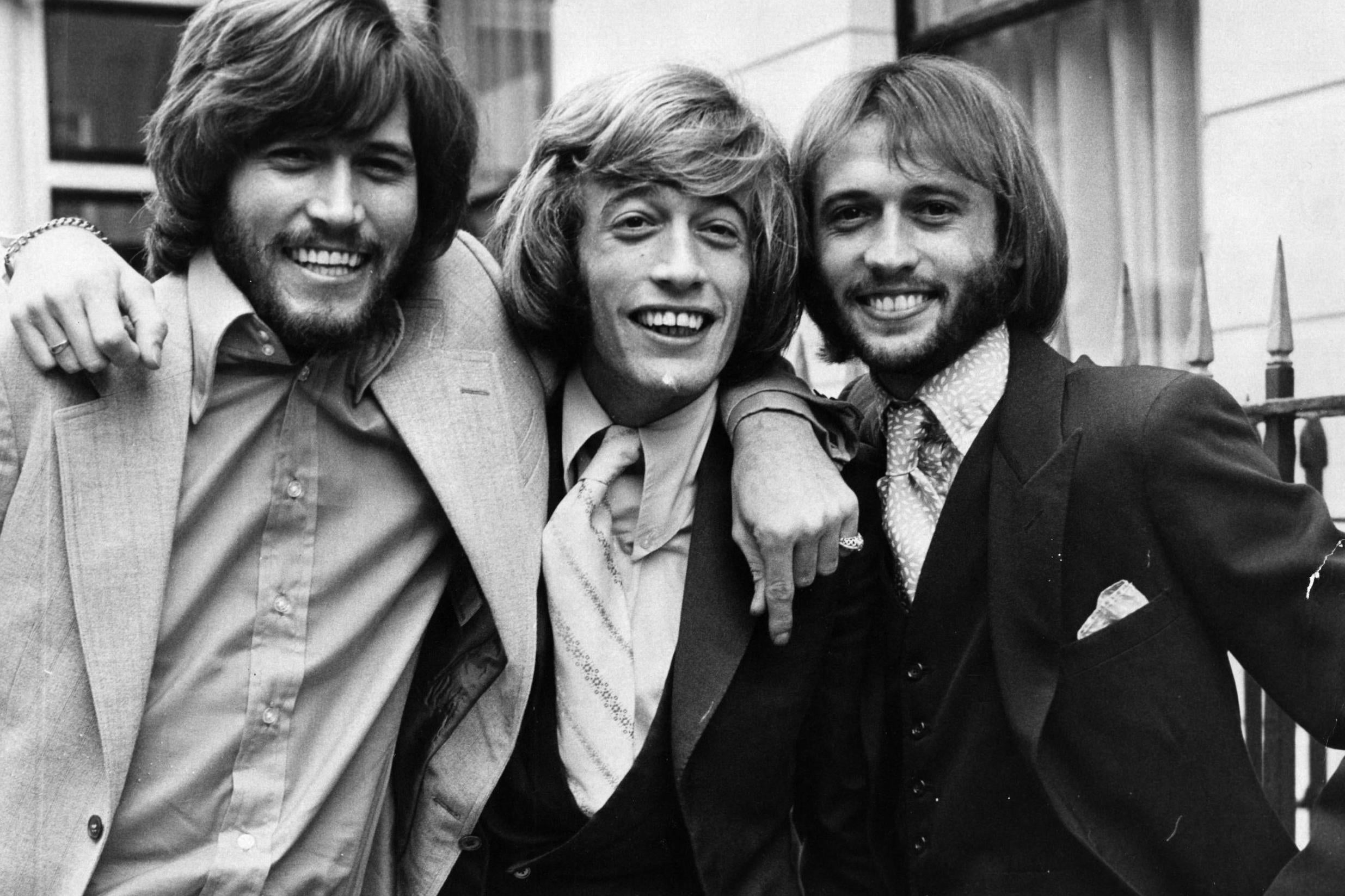
And for perhaps the first time, Maurice stepped fully into the spotlight.
For longtime listeners, the emotional impact of that moment is difficult to describe. Maurice Gibb spent much of his career as the stabilizer inside the Bee Gees machine. He played bass, keyboards, guitar, and virtually anything the music required. He shaped arrangements, strengthened harmonies, and understood how to support a song without overpowering it. In the studio, he was part of the architecture beneath the Bee Gees’ unmistakable sound. Onstage, he brought warmth, humor, and timing that balanced the intensity of his brothers. Within the family itself, he often acted as the bridge between two strong creative personalities.
That is what makes the title “Man in the Middle” feel so haunting today. It was not simply a song title. It was almost a confession.
Maurice was literally and emotionally the middle figure in the Bee Gees — Robin’s twin, Barry’s younger brother, and the quiet mediator standing between ambition, tension, loyalty, and reconciliation. The song carried the emotional truth of someone who understood that being “in the middle” could be both meaningful and lonely. When Maurice sang about a man trapped inside a complicated plan, the performance felt deeply personal. His voice did not chase dramatic power. Instead, it carried something more intimate: reflection, vulnerability, and acceptance.
What makes the performance even more heartbreaking in hindsight is how joyful it begins. Barry introduces the song with playful humor, and Maurice responds with the relaxed confidence of a man entirely comfortable in his own identity. Wearing dark glasses, a fedora, and a black leather jacket, he never appears desperate for attention. He simply receives it naturally. Even his small exchanges with the audience reveal the effortless charm fans adored for decades. Maurice possessed a rare quality: he could be funny without trying too hard, humble without fading into the background, and charismatic without ever overshadowing those around him.

For many older and thoughtful listeners, this performance speaks to something far beyond music. It reminds people of the quiet figures inside every family — the ones who keep peace, support others, carry emotional weight silently, and are often appreciated most deeply only after they are gone. That is why Maurice Gibb’s legacy has only grown stronger with time. His greatness was never built on dominance or ego. It was built on devotion.
Tragically, only two years after that performance, Maurice Gibb passed away at the age of 53. His death shattered the balance that had defined the Bee Gees for decades. Their chemistry was never something that could be recreated by another musician. It was blood, memory, rivalry, love, and instinct fused together through music. Without Maurice, something irreplaceable disappeared forever.
Today, revisiting “Man in the Middle” feels less like watching a performance and more like opening a living memory. Every smile feels heavier. Every glance between the brothers carries unspoken meaning. What once seemed modest now stands as one of the clearest portraits of who Maurice Gibb truly was.
He may have called himself the man in the middle.
But history now understands the deeper truth: Maurice Gibb was the heart quietly holding the Bee Gees together.