INTRODUCTION:
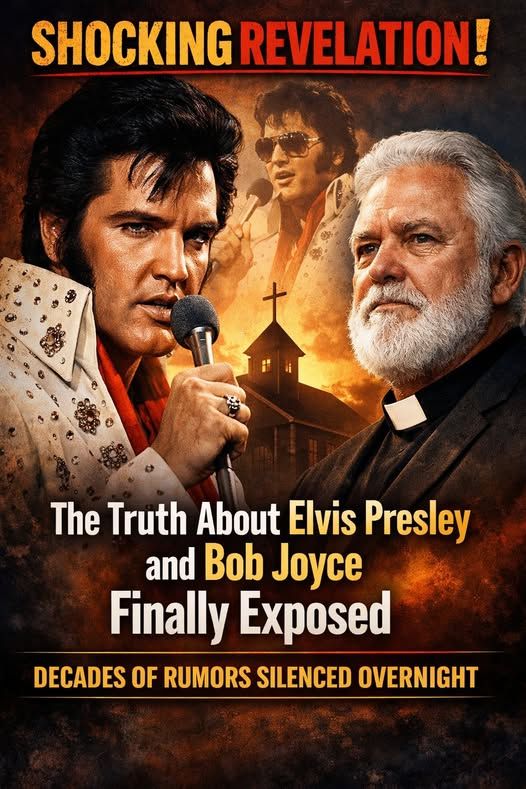
For decades, one question refused to fade quietly into history — What if Elvis Presley never died?
It is a question that lives in the spaces between grief and disbelief, between admiration and longing. For some, it began as a whisper. For others, it became a conviction. And for the internet, it evolved into a self-sustaining storm of speculation that blurred the line between curiosity and certainty.
At the center of that storm stood two names, forever linked by rumor rather than reality: Elvis Presley and Bob Joyce.
Side-by-side images flooded social media. Video clips slowed to half speed. Vocal tones were dissected note by note. Every pause, every breath, every familiar inflection was treated as evidence. Comment sections transformed into courtrooms. Amateur analysts became digital detectives. And the theory grew louder with each click:
The King didn’t die. He disappeared.
It was dramatic.
It was emotional.
And it was nearly irresistible.
But the truth — the real truth — does not rely on mystery to survive. It stands quietly, supported by time, records, and human reality. And now, after years of recycled speculation, selective editing, and hopeful distortion, the truth cuts cleanly through the noise.
Not to diminish Elvis Presley’s legacy — but to protect it.
Why The Rumor Took Hold
To understand why this theory flourished, one must first understand what Elvis Presley represented. He was not merely a singer. He was a cultural rupture. A force that reshaped music, performance, and identity in America and far beyond it.
When Elvis died in 1977, the world didn’t simply lose an artist. It lost a presence. For millions, that loss felt unfinished — abrupt, unresolved, unfair. Grief seeks answers. Sometimes, it seeks alternatives.
Into that emotional vacuum stepped the idea of survival.
Over the years, countless “sightings” appeared. Gas stations. Airports. Remote towns. Anonymous stories passed along without verification. None held up under scrutiny — but they didn’t need to. They fed something deeper than logic: the desire to believe that legends don’t fade, they retreat.
Then came the internet.
Algorithms reward resemblance. Viral platforms favor mystery. A single clip, taken out of context, can become a global talking point overnight. When videos of Bob Joyce singing gospel music began circulating online, the similarities — real or perceived — were amplified far beyond proportion.
And suddenly, a new chapter of the rumor was born.
Who Elvis Presley Really Was — And Why His Story Is Not A Secret
Elvis Presley’s life is among the most documented in entertainment history. Born in Tupelo, Mississippi, in 1935, his journey from poverty to global influence is preserved in recordings, contracts, photographs, interviews, and firsthand accounts.
His final years were not hidden. They were witnessed — by family, friends, doctors, staff, and fans. His death was investigated, recorded, and publicly mourned. His burial site became a place of pilgrimage. His legacy became institutionalized not because it needed protection, but because it demanded preservation.
There is no missing chapter.
There is no erased identity.
There is no alternate life hidden between the lines.
What persists instead is something far more enduring: influence.
Elvis did not need to survive physically to remain present culturally. His voice, style, and impact continue to echo precisely because his story has an ending — and endings are what give stories meaning.
Who Bob Joyce Is — And Who He Is Not
Bob Joyce is not a secret identity. He is not a coded return. He is not a living disguise.
He is a pastor and gospel singer with his own history, his own calling, and his own community. His life exists outside the mythology of Elvis Presley, even if the internet insists on merging the two.
The resemblance that fueled speculation was superficial and selective. Vocal tone, especially in gospel music, follows tradition. Cadence, phrasing, and emotional delivery are shared across generations. What sounds “familiar” is often inherited, not hidden.
But familiarity does not equal identity.
Bob Joyce never claimed to be Elvis. He never encouraged the rumor. In fact, the theory was constructed around him, not by him — shaped by viewers projecting their hopes onto a man who was simply doing what he had always done: singing gospel music.
Why The Internet Wanted This To Be True
The persistence of this theory says more about us than it does about Elvis or Bob Joyce.
In an age where reality feels unstable, the idea that a beloved figure escaped tragedy feels comforting. It suggests control over fate. It implies that loss can be negotiated. That endings are optional.
But this mindset comes at a cost.
When we refuse to accept truth, we dilute legacy. We reduce real lives into symbols for unresolved emotion. Elvis Presley becomes less a human being and more a puzzle. Bob Joyce becomes less a pastor and more a projection.
Neither deserves that.
The Difference Between Mystery And Meaning
There is a temptation to believe that truth is boring and mystery is exciting. But in reality, meaning does not come from unanswered questions — it comes from understanding.
Elvis Presley’s life matters because it was lived fully, visibly, and honestly. His struggles do not diminish his greatness; they define it. His death does not erase his influence; it cements it.
And Bob Joyce’s life matters because it is his own — not because of who he is mistaken for.
The Truth That Ends The Story
So here it is, without dramatics or sensationalism:
Elvis Presley lived.
Elvis Presley died.
And Elvis Presley changed music forever.
Bob Joyce is not Elvis Presley.
He never was.
He never claimed to be.
The resemblance was coincidence.
The rumor was amplified.
The truth remained unchanged.
What endures is not a secret survival story — but a legacy powerful enough that people struggled to let it go.
And perhaps that is the most honest tribute of all.
Because legends don’t need to return under new names to remain alive.
They live on because the world remembers them — clearly, truthfully, and without distortion.