INTRODUCTION:
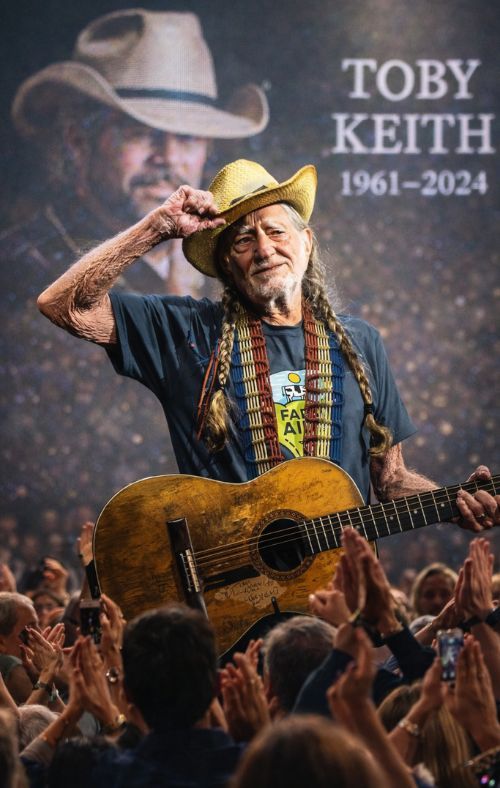
WILLIE NELSON AND TOBY KEITH
How Beer for My Horses Quietly Became a Modern Western Creed
When Beer for My Horses arrived in 2003, it didn’t knock politely on country radio’s door. It leaned back in its chair, tipped its hat, and spoke in plain language — the kind that doesn’t ask permission because it doesn’t feel the need to explain itself. From the first bars, it sounded less like a single chasing airplay and more like a statement already settled in its own mind.
When Toby Keith and Willie Nelson joined voices, it wasn’t framed as a flashy collaboration. It felt closer to something older and quieter: two generations agreeing, without ceremony, on an unwritten code. Loyalty matters. Wrongdoing has consequences. And in a complicated world, people still crave a clear sense of right and wrong — even if it comes wrapped in humor and a raised glass.
On the surface, the song is easygoing and hook-heavy. It rolls by like dusk through an open pickup window, familiar and unbothered. But older audiences heard something else immediately. Beneath the grin was a modern Western morality play — dressed in everyday language, delivered with swagger, and grounded in values that predate trends, charts, and debates.
Why This Duet Felt Different From The Start
Country music has always trafficked in storytelling, but Beer for My Horses stood out because it didn’t tell a long tale. It made a declaration. The verses and chorus didn’t wander — they planted their feet. There was no ambiguity about the worldview being presented. Justice wasn’t abstract. Honor wasn’t ironic. Consequences weren’t outsourced.
That clarity mattered in 2003 more than many realized at the time. The cultural mood was already shifting. Certainty was beginning to feel unfashionable. Nuance was replacing conviction. And here came a song that refused to apologize for believing that some lines still mattered.
The presence of Willie Nelson was crucial. He didn’t arrive as a novelty guest. He arrived as validation. When Willie sings, history listens. His voice carried decades of outlaw credibility, lived experience, and cultural memory. Paired with Toby Keith’s directness, the effect was not confrontation, but confirmation.
This wasn’t rebellion for rebellion’s sake. It was continuity.
A Western Code Without Costumes
What made the song resonate so deeply with older listeners was its refusal to romanticize complexity. It didn’t pretend the world was neat — it simply insisted that responsibility still existed within it. That insistence felt familiar to generations raised on Westerns, rural ethics, and community accountability.
In classic Western storytelling, justice is rarely elegant. It is personal. It happens face-to-face. Beer for My Horses borrowed that spirit without borrowing the costumes. No horses needed saddles. No sheriffs needed badges. The moral framework was enough.
That framework spoke to listeners who recognized something slipping away — not because the song said so, but because it sounded so sure of itself.
Why It Lasted When Others Didn’t
Plenty of catchy songs come and go. Few outlive their moment. Beer for My Horses endured because it offered more than melody. It offered certainty — not political certainty, but moral certainty. The sense that some truths don’t need constant revision.
That kind of confidence ages well with audiences who have watched values cycle in and out of fashion. For them, the song didn’t feel reactionary. It felt rooted.
It also helped that the delivery never felt angry. There was humor in it. Ease. A knowing smile. The song didn’t shout its beliefs — it stated them, then leaned back and let listeners decide whether they recognized themselves in it.
Many did.
Two Voices Signing The Same Code
The real power of the song lies in the partnership. Willie Nelson and Toby Keith were never meant to sound the same — and that was the point. One carried the gravel of experience. The other carried the bluntness of conviction. Together, they formed something balanced: tradition meeting immediacy.
It felt like a passing of the torch without ceremony. No speeches. No explanations. Just agreement.
And that agreement resonated far beyond the charts.
Why It Still Gets Played
Years later, the song still finds its way into playlists, bars, backyard gatherings, and long drives. Not because it feels retro, but because it feels steady. In a culture that often questions itself out loud, Beer for My Horses doesn’t question much at all.
It stands where it stands.
For older audiences especially, that steadiness is the appeal. It reminds them of a time — or perhaps a mindset — when conviction wasn’t something to soften or disguise. When music didn’t need to hedge. When a song could smile, tap its boot, and still mean exactly what it said.
A Creed Disguised As A Chorus
What ultimately made Beer for My Horses last wasn’t controversy or novelty. It was recognition. Listeners heard something they already believed, expressed without pretense. A modern Western creed, delivered in plain clothes.
Justice.
Honor.
Loyalty.
And yes — a cold one at the end of the day.
Not because the world is simple.
But because, sometimes, people still want it to make sense.