INTRODUCTION:
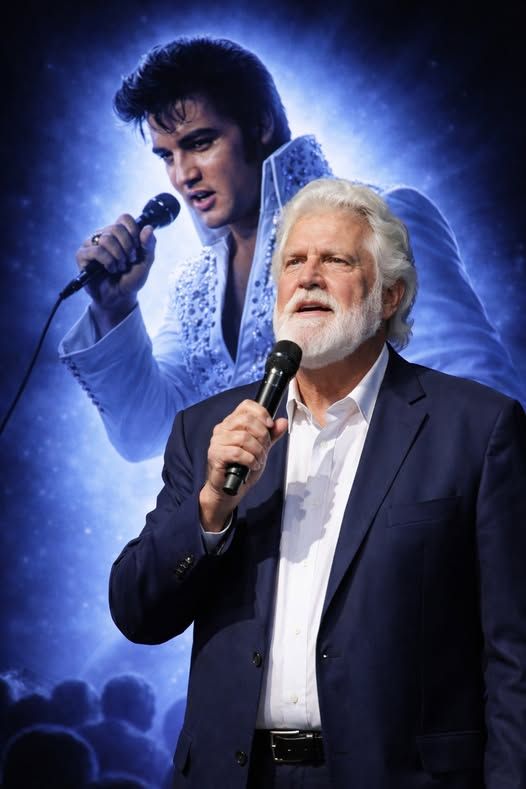
Headlines like “GLOBAL SHOCKWAVE” are engineered to stop the scroll — and the story you’ve just seen does exactly that. It claims that at a final concert labeled “ONE LAST RIDE – ELVIS PRESLEY 2025,” Bob Joyce allegedly declared, “I am Elvis. I survived. My memory is back.” The narrative continues with images of an arena in chaos, stunned fans, and a supposed reckoning decades in the making.
It is dramatic.
It is emotional.
And it is not supported by verifiable evidence.
To understand why this claim spreads — and why it does not hold — we need to separate storytelling from substantiation, and longing from fact. Doing so protects not only history, but the dignity of the people whose names are being used.
The Immediate Red Flags
Before belief comes verification. In this case, the most basic checks raise immediate concerns:
-
No confirmed event exists under the title “ONE LAST RIDE – ELVIS PRESLEY 2025.”
-
No reputable venue, promoter, or ticketing platform has listed such a concert.
-
No credible news organization has reported a public confession of this magnitude.
-
No audio, video, or transcript from a verifiable source corroborates the quoted statement.
Extraordinary claims require extraordinary evidence. Here, none has been presented.
Why Elvis Presley Cannot “Return”
The life and death of Elvis Presley are among the most documented in modern culture. His medical history, final days, death certification, funeral, burial, and estate management have been examined repeatedly over nearly five decades by journalists, biographers, physicians, and historians.
There is no credible gap in the record that allows for a hidden survival.
There is also no plausible mechanism by which Elvis Presley could have lived anonymously for decades without leaving a verifiable trail — legal, medical, financial, or personal — especially in an age where records are interconnected and independently auditable.
Claims of recovered memory, secret identities, or staged deaths belong to fiction unless supported by transparent, independently verified proof. None exists here.
Who Bob Joyce Actually Is
Bob Joyce is a pastor and gospel singer with a documented life and ministry of his own. He has never provided verified evidence that he is Elvis Presley, nor has he produced documentation — genetic, legal, or historical — to support such an assertion.
Importantly, viral narratives often assign words to people without proof. A quotation circulating online is not evidence that it was spoken, much less spoken publicly at a real event. This is a common tactic in misinformation: the authority of a name is used to carry a story that collapses when examined.
How These Stories Go Viral
This kind of claim thrives for predictable reasons:
-
Emotional leverage – Elvis Presley occupies a unique place in cultural memory.
-
Algorithmic amplification – shocking content travels faster than careful analysis.
-
Ambiguity by design – the absence of proof is framed as secrecy.
-
Visual suggestion – unrelated crowd footage or concerts are reused to imply authenticity.
The result feels convincing — not because it is true, but because it is engineered to feel true.
The Ethical Cost of Belief
Believing and spreading unverified claims has consequences:
-
It distorts historical understanding of Elvis Presley’s life and legacy.
-
It misrepresents Bob Joyce, reducing a real person to a symbol for someone else’s mythology.
-
It rewards misinformation, encouraging increasingly extreme fabrications.
Respect for artists includes respecting truth.
What Would Real Proof Look Like
If such a claim were genuine, it would be accompanied by:
-
Independent DNA verification from accredited laboratories
-
Public documentation examined by multiple institutions
-
Coverage by major news organizations with fact-checking standards
-
Legal ramifications acknowledged by estates, courts, and authorities
Absent all of this, the claim remains what it is: a viral story, not a revelation.
Why the Myth Refuses to Die
The persistence of Elvis survival stories says less about hidden truths and more about collective emotion. Elvis Presley was more than a performer; he was a cultural force. For many, ordinary mortality feels insufficient for someone who shaped music and identity so profoundly.
But meaning does not require mystery to endure.
Elvis Presley’s legacy is secure precisely because it is real, documented, and influential — not because it is hidden.
The Bottom Line
There was no confirmed 2025 concert.
There was no verified confession.
There was no revelation that rewrote history.
What exists instead is a familiar cycle: shock, speculation, sharing — and then silence when facts are requested.
Legends don’t need sensational endings to remain powerful.
And truth does not need chaos to stand.
In honoring Elvis Presley, the most respectful choice is clarity — not conspiracy.