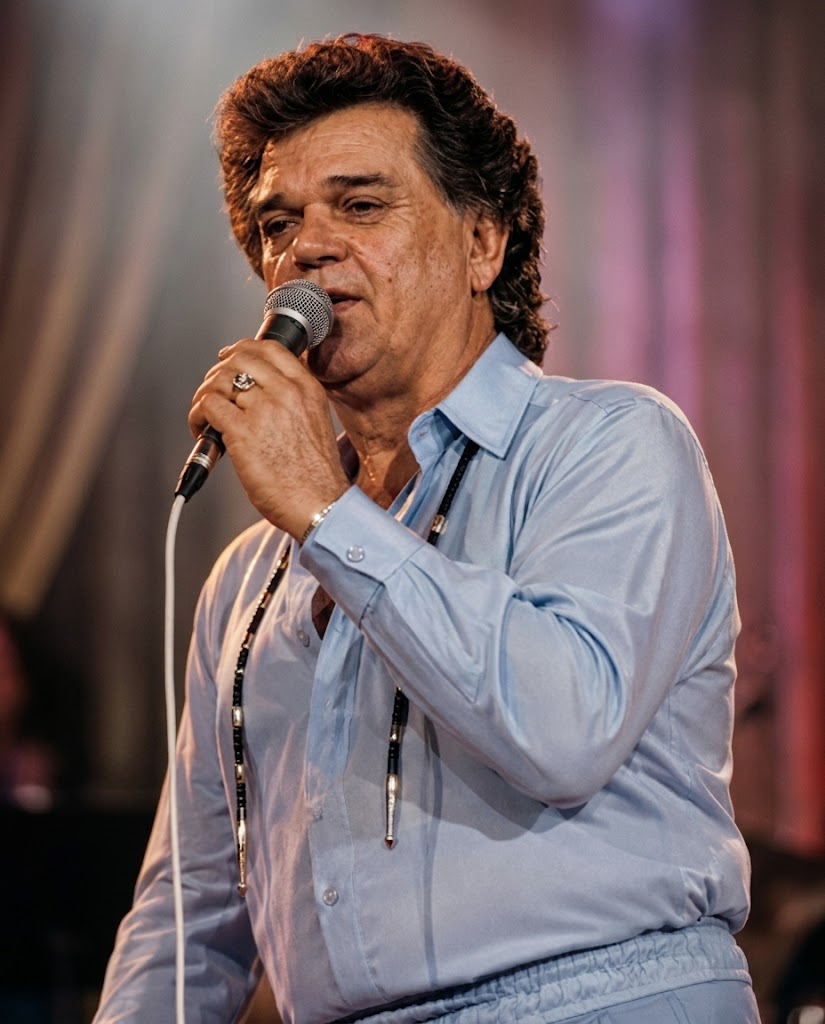
Introduction:
In the early 1970s, country music was undergoing a revolution.
The polished rules of Nashville were beginning to crack as a new generation of artists pushed back against tradition. The outlaws arrived wearing faded denim and weathered boots, singing about prison walls, hard living, cheap whiskey, and life beyond the boundaries of respectability.
Country music expected its rebels to be loud.
Conway Twitty was anything but.
With his perfectly styled hair, tailored suits, and unmistakably gentle presence, Conway seemed like the safest man in Nashville. He was the polished gentleman of country music—the voice behind countless love songs that had already earned him a loyal audience across America.
No one expected him to become controversial.
But sometimes, the most powerful rebellion does not arrive with a roar.

Sometimes, it arrives as a whisper.
In the summer of 1973, Conway released “You’ve Never Been This Far Before.”
The song contained no violence, no barroom brawls, and no outlaw bravado. It was quiet, intimate, and deeply personal.
Yet almost immediately, radio stations across the country began to panic.
Several major broadcasters refused to play the record, calling it too suggestive and too intimate for traditional country audiences. Industry executives who had little concern for songs about cheating, drinking, or men running from the law suddenly drew the line at emotional vulnerability.
A man speaking honestly about desire, tenderness, and uncertainty behind closed doors felt far more dangerous.
Conway understood something many of his louder contemporaries never fully grasped: real temptation rarely announces itself with a shout.
It arrives softly.
It waits for silence.
When Conway sang those low, trembling lines, he was not performing for a packed arena. He was singing to the lonely driver sitting in a parked car long after midnight, letting the engine idle just to hear the final verse.
He was speaking to people sitting alone in dimly lit living rooms, carrying feelings they could never quite put into words.
That was Conway Twitty’s extraordinary gift.
Long before he conquered country music, he had been a rock and roll star whose popularity rivaled some of the biggest names of his era. But he walked away from the bright lights of pop stardom because he wanted to tell more mature stories—stories about love, regret, longing, and the complicated emotions that define adult life.

When he arrived in Nashville, critics questioned whether a former rock singer could survive in a genre built on authenticity.
Conway never argued.
He simply stepped up to the microphone, closed his eyes, and stripped away every layer of emotional armor men were expected to wear.
There was no distance between his voice and the listener’s heart.
Listening to Conway felt almost too intimate, like discovering a private diary that was never meant to be read by anyone else.
More than three decades after his passing in 1993, that velvet voice still holds its power.
His legacy remains a reminder that truth does not need volume to leave an impact.
Conway Twitty proved that you do not have to raise your voice to make the world stop and listen.
You simply lower it—and leave your audience with nowhere left to hide.
Somewhere tonight, a radio flickers to life in the darkness.
For three unforgettable minutes, the room belongs to him once again.