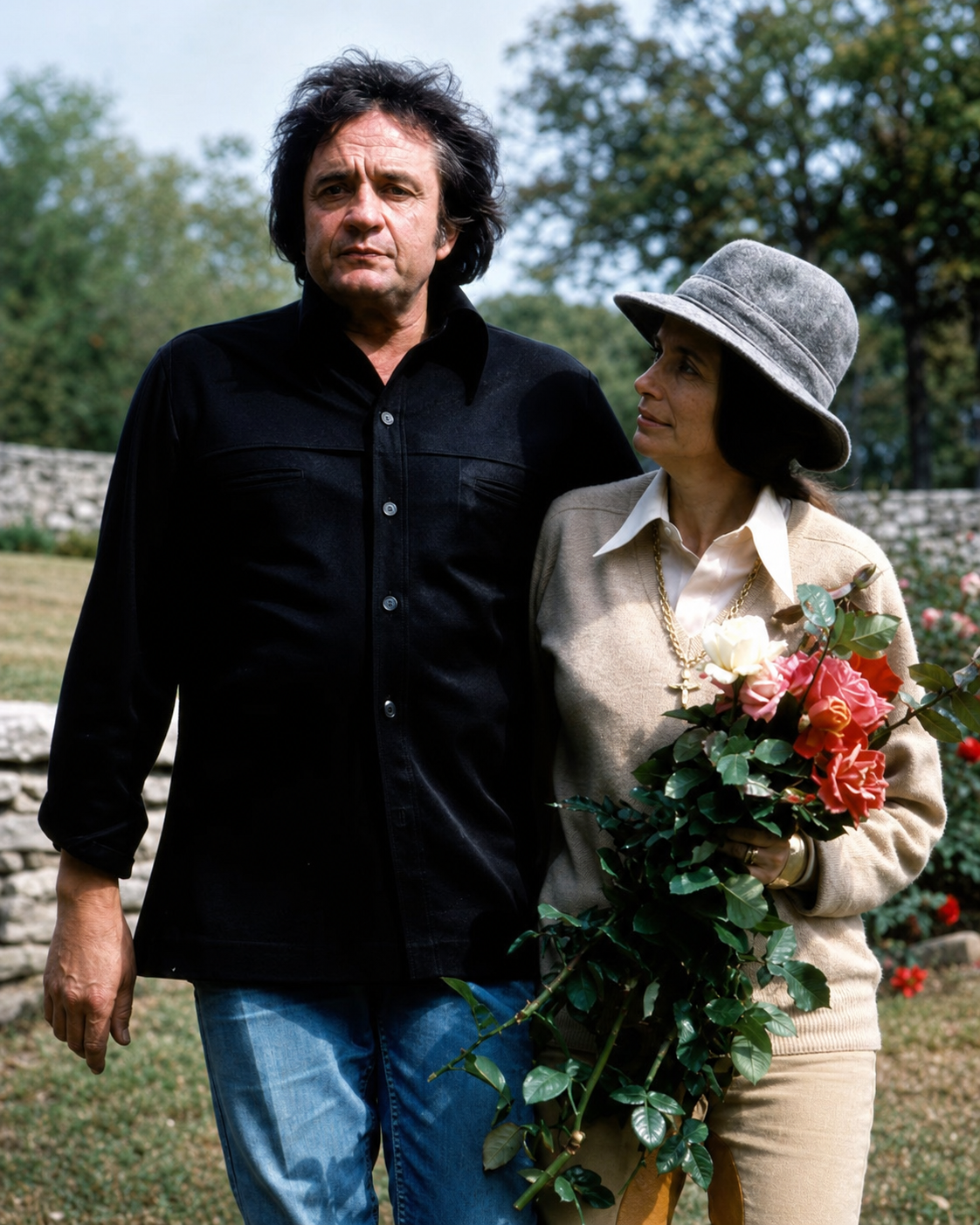
Introduction:
June Carter and Johnny Cash: The Promise That Changed a Country Music Life
By the late 1960s, Johnny Cash had already become one of the most recognizable voices in country music. He sounded like thunder rolling across a lonely highway—commanding, raw, unforgettable. With just one note, one stare, and that signature black coat, he could fill a room with stories of trouble and redemption. But behind the stage lights and roaring crowds, Cash was fighting a private battle that fame could not soften.
By 1967, exhaustion had turned into something far more dangerous. The relentless touring, personal losses, and mounting pressure had pushed him to the edge. To the world, he remained a towering figure. To those closest to him, he was a man quietly unraveling.
June Carter saw what others refused to face.
Raised in the heart of country music as the daughter of Maybelle Carter, June understood that music was more than performance—it was survival. She knew hardship, faith, humor, and resilience. More importantly, she knew that loving someone did not mean ignoring the truth.

A Woman Who Refused to Look Away
Many admired Johnny Cash. Many depended on him. But June Carter did something rare—she saw both the legend and the wounded man beneath. She did not treat him like a headline or a lost cause. Instead, she stayed close enough to witness his lowest moments: the anger, the fear, and the silence when pride had nothing left to say.
Her love was not distant or passive. It was present, steady, and unafraid.
Stories of that time have taken on an almost mythic quality—June standing firm as chaos threatened to consume him. Whether told through family memories or music history, the truth remains clear: she did not love him blindly. She loved him with courage, with boundaries, and with a strength that could say “no” when it mattered most.
Sometimes, love is not gentle. Sometimes, it is a door held shut against everything trying to break someone apart.
The Conditions of Love
June Carter’s love came with clarity. She was warm, vibrant, and deeply musical—but never weak. She understood that a lasting relationship could not be built on talent alone, nor sustained by applause. If Johnny Cash wanted a future with her, he had to choose life—again and again.
Her promise was not automatic. It was conditional.
He had to confront the forces destroying him. He had to be present, honest, and willing to change. In that sense, June was not simply standing beside him—she was standing between him and the ending many feared.
The Proposal Heard Around the World
On February 22, 1968, during a live performance in London, Ontario, the story reached a turning point. Performing their fiery duet “Jackson,” Cash suddenly stopped mid-show. In front of thousands, he turned to June Carter and asked her to marry him.
Caught off guard, she urged him to continue the song. But he refused to let the moment slip away. The question lingered in the air—public, vulnerable, and impossible to ignore.
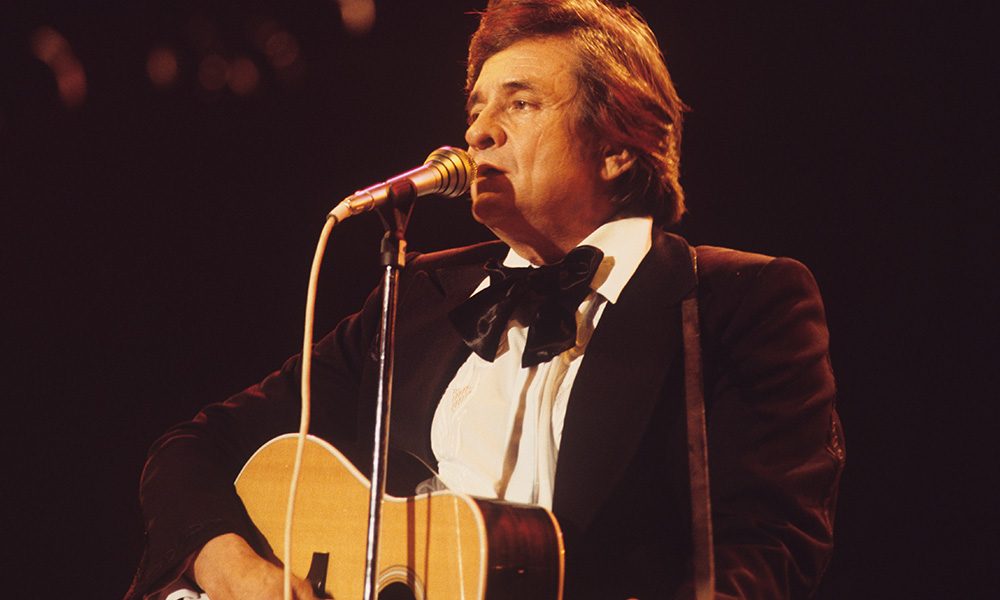
Finally, she said yes.
It was more than a romantic gesture. It marked the beginning of a 35-year marriage—one that would become one of country music’s most enduring partnerships. Their relationship was not perfect, but it was real. It carried storms and forgiveness, laughter and faith, music and resilience.
A Love Story With a Backbone
In an era where love stories are often polished for public approval, the bond between June Carter and Johnny Cash stands apart. It was not built for appearances. It was built in difficult moments, honest conversations, and unwavering commitment.
June did not “save” Johnny by pretending he was fine. She loved him enough to demand truth, growth, and accountability. That is what gives their story its lasting power—it was not fantasy, but a fight for a future.
Johnny Cash became known as the Man in Black, a symbol of darkness and defiance. But June Carter was the light that refused to leave. She did not erase every shadow—she simply refused to let those shadows win.
And that is why their story still resonates today. June Carter was not just the woman Johnny Cash married. She was the woman who stood in front of the darkness and declared, with quiet strength, that this was not how the song would end.