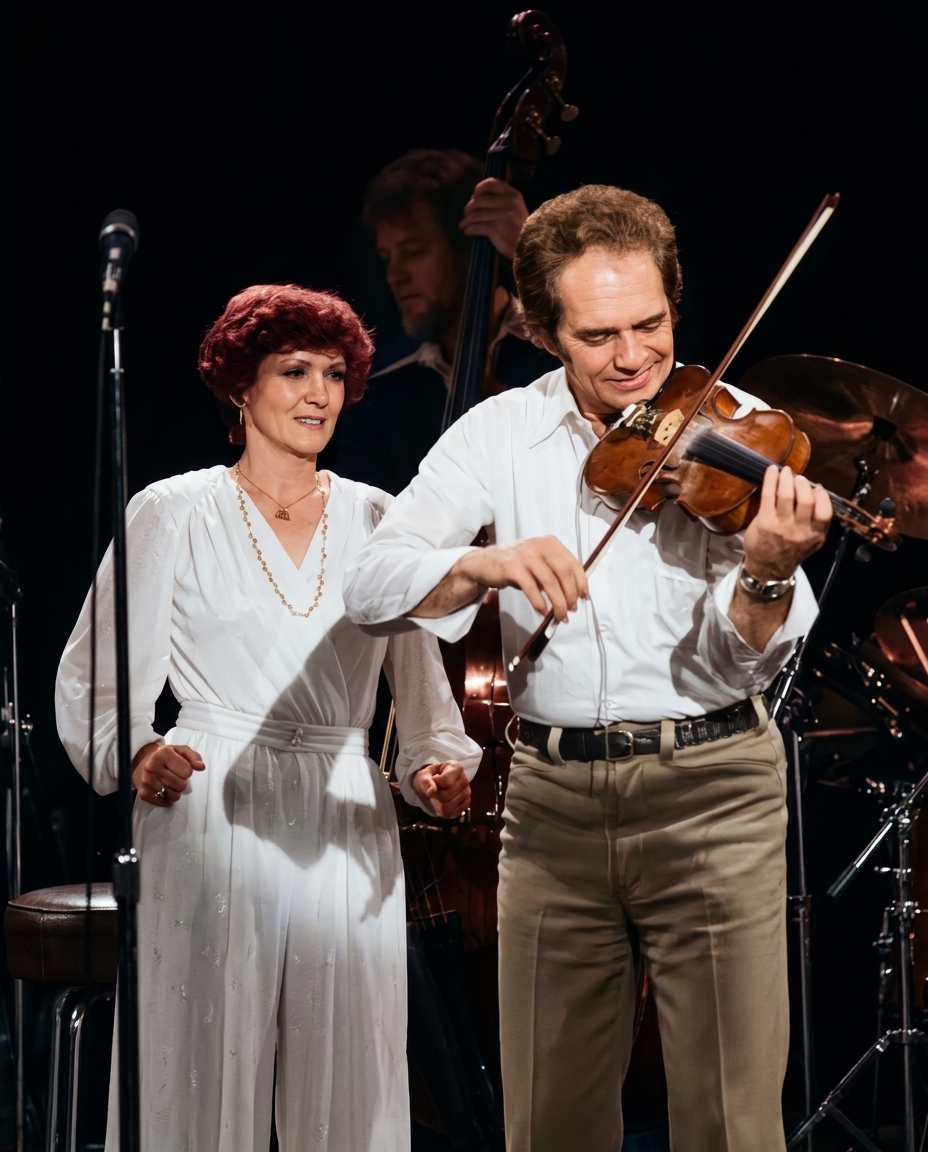
Introduction:
In country music, truth rarely arrives in simple form. It comes layered with contradiction—tenderness wrapped around regret, loyalty shadowed by loss. Few stories embody that emotional complexity more vividly than the bond between Merle Haggard and Bonnie Owens—a relationship that may not have lasted in marriage, but endured through music in a way that still resonates decades later.
When Merle Haggard married Bonnie Owens in 1965, their union already carried the texture of a country ballad. Bonnie had previously been married to Buck Owens, a defining figure of the Bakersfield sound that Haggard himself helped shape. Yet what could have been reduced to tabloid intrigue instead became something far more meaningful. Bonnie was not merely part of Haggard’s personal life—she became integral to his creative world.
Behind the scenes, Bonnie Owens played a quiet but essential role in shaping Haggard’s music. She listened with care, offered insight when songs were still fragile ideas, and helped refine the emotional core before it ever reached an audience. In an industry that often spotlights the voice at center stage, her influence lived in the structure, the restraint, and the emotional clarity of the songs themselves. She was, in many ways, one of the unseen architects of Haggard’s sound.

One of the most enduring pieces of their shared legacy began not in a studio, but in a simple, unguarded moment. According to the story that has followed it through the years, Haggard once said quietly, “I finally have time to love you again.” Bonnie immediately recognized the weight of those words. What might have passed as a fleeting sentiment became something more. She picked up a pen, and together they began shaping what would become “Today I Started Loving You Again.”
The song itself is disarmingly simple. It does not rely on grand declarations or elaborate storytelling. Instead, it carries a quiet emotional power—balancing regret and devotion in a way that feels both intimate and universal. That subtlety is precisely why it endured. Over time, it became one of those rare songs that artists return to again and again, each finding something personal within its lines. Yet no matter who recorded it, the song always seemed to echo back to the complicated tenderness between Haggard and Owens.
In 1978, their marriage came to an end. By all expectations, that should have closed the chapter. But their story refused to follow a conventional ending. Bonnie Owens returned to the stage—not as Haggard’s wife, but as his backup singer. Night after night, they performed side by side, sharing the same space, the same songs, and the same history. Among those songs was the very one they had created together. There is something quietly profound in that image: two people no longer bound by marriage, yet still connected by a melody that refused to let go.

As the years passed, “Today I Started Loving You Again” evolved beyond its origins. It became more than a love song; it became a reflection of time itself—a confession, a wound, and perhaps a form of grace. Audiences may not have known every detail of their history, but they could feel its truth. Sometimes, a glance across the stage or a pause between lines can carry more meaning than words ever could.
In 1996, Haggard reportedly said, “I still love Bonnie.” It was not an attempt to rewrite the past, nor to erase the distance that had grown between them. Instead, it confirmed what many had long sensed: that some connections do not end cleanly. They linger, reshaped but not erased.
Bonnie Owens passed away in 2006. A decade later, in 2016, Merle Haggard followed. Their story, in one sense, reached its final note. Yet what remains is not only the memory of a marriage, but the echo of a song that carried their shared truth across time.
That is why their story still matters. It is not simply about love or loss, but about the way music preserves what life cannot resolve. Merle Haggard and Bonnie Owens may not have held onto their marriage, but they held onto something just as lasting—a song that continues to speak long after the final performance fades. In country music, that kind of legacy is its own version of forever.