
Introduction:
The Quiet Beginning of a Legend: Elvis Presley’s Early Years in East Tupelo
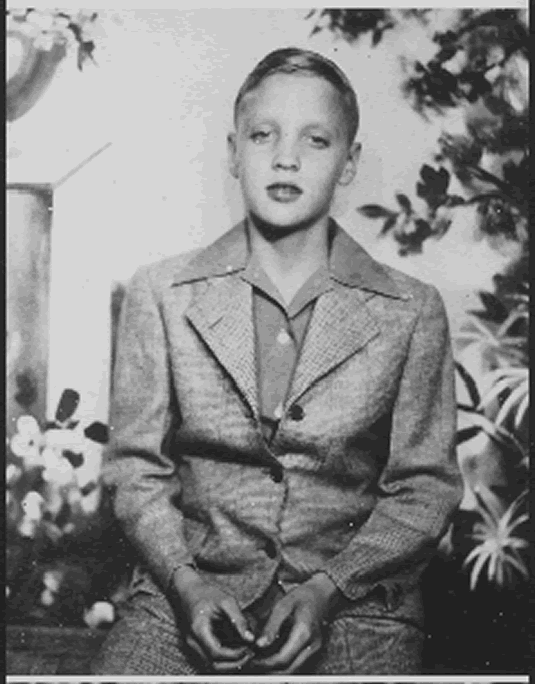
A childhood photograph of Elvis Presley, taken when he was around nine or ten years old, carries a quiet but undeniable power. At first glance, it is an ordinary image: a young boy standing still for the camera, dressed simply, his posture modest and unassuming. There are no stage lights, no costumes, no screaming crowds. There is only a child from East Tupelo, Mississippi, looking into a world he has not yet changed.
Yet what makes the photograph unforgettable is not what it shows, but what it suggests. Elvis does not appear as a future global icon or the man who would redefine popular music. Instead, he is simply a boy shaped by his surroundings—gentle-faced, observant, and quietly thoughtful. In his eyes, however, there is something harder to define. A softness, yes, but also a faint spark, as if life had already begun placing music into him long before he understood its purpose.
The world Elvis was born into in the 1940s was far from easy. The Presley family lived in East Tupelo with very limited means, often navigating uncertainty in their daily lives. Their home was a small two-room structure, humble and fragile against the pressures of poverty. Stability was never guaranteed, and comfort was a luxury they rarely experienced. Yet within those conditions, something deeply formative was taking shape.
Out of hardship came a foundation that would later define Elvis Presley’s identity. Faith was central to family life, offering emotional grounding in difficult times. Music, too, was everywhere—not as entertainment, but as a form of survival and expression. The gospel songs heard in church carried emotional intensity and spiritual depth. The blues drifting through the local community introduced rhythm, pain, and storytelling. And at the center of his world was his mother’s love, a constant source of warmth and encouragement.
These influences did not simply surround Elvis; they became part of him. They shaped the emotional honesty that would later define his voice and performance style. Long before fame, records, and international recognition, Elvis was absorbing the sounds and feelings of his environment, unknowingly building the foundation of his artistic identity.

When success eventually arrived, it came in overwhelming waves—hit records, global fame, and audiences that stretched across continents. But the childhood image of Elvis Presley offers a necessary reminder: greatness did not begin with applause. It began in silence, in simplicity, and in struggle.
What is most striking is how unchanged his essence seems across time. The kindness, emotional depth, and soulful sensitivity that audiences later admired were not inventions of fame. They were already present in that young boy standing in front of a camera in East Tupelo. Fame did not create those qualities; it revealed them on a larger stage.
In the end, the photograph is more than a glimpse into the past. It is a reminder that even the most iconic figures in history begin as ordinary children shaped by ordinary circumstances. And sometimes, within those quiet beginnings, the world’s most extraordinary stories are already waiting to unfold.