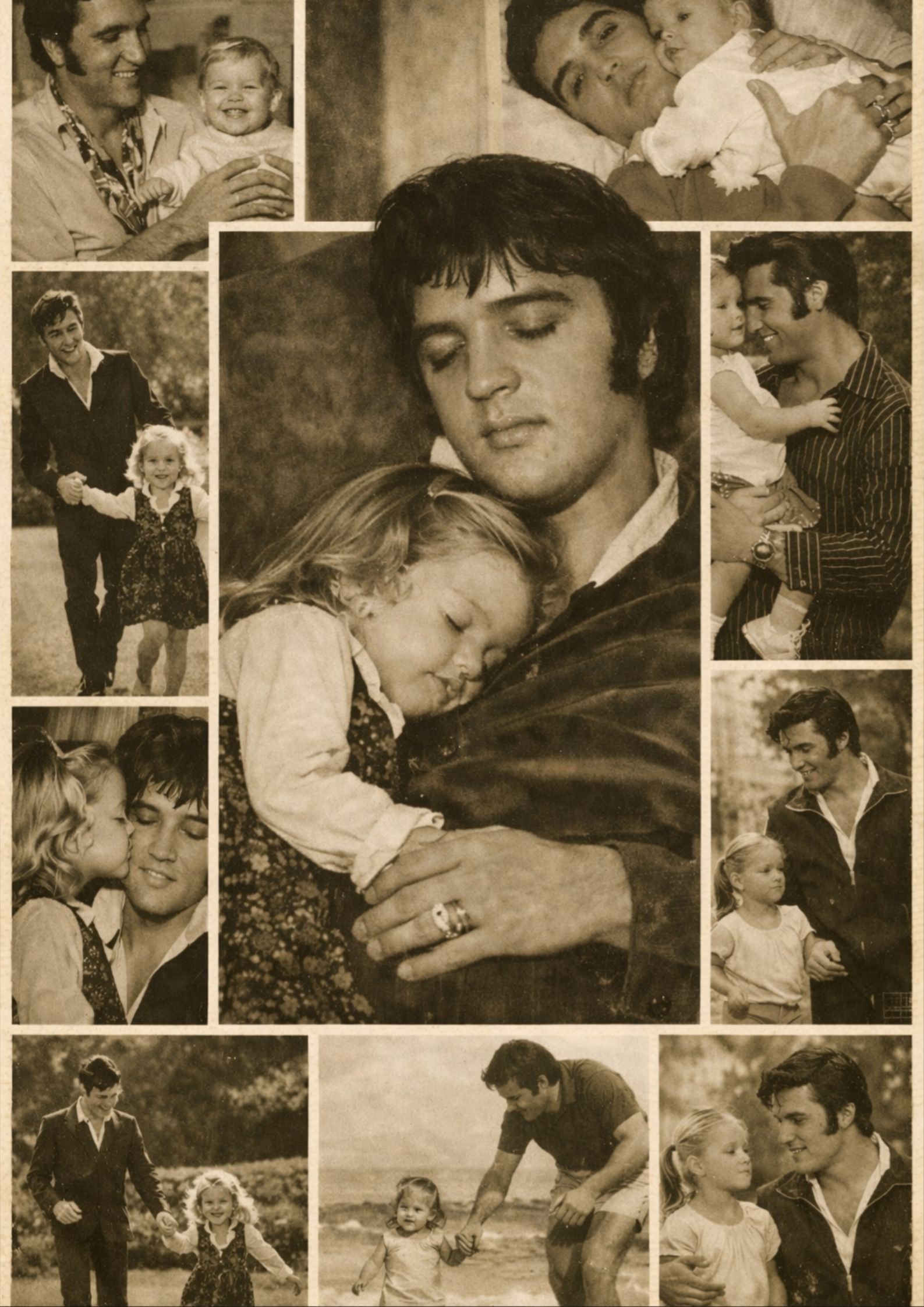
Introduction:
Some recordings invite you in. Others cross a line you didn’t realize was there. This one—built around Don’t Cry Daddy—feels less like listening and more like stepping into something deeply private, almost sacred, as if a door has been opened that was never meant for the public at all.
When Elvis Presley first recorded the song in 1969, it already carried a quiet, devastating weight. Stripped of spectacle, far removed from the glitter of Las Vegas or Hollywood, Elvis delivered something far more fragile: a portrait of a father trying not to collapse under grief, seen through the innocent eyes of a child. There is no dramatic crescendo, no theatrical release. Instead, there is restraint—an aching stillness that mirrors how real sorrow behaves. It lingers in pauses, in softened tones, in the effort it takes simply to keep going.
For decades, that performance stood on its own—intimate, almost uncomfortably so. And then, years later, something extraordinary happened. Lisa Marie Presley stepped into the silence her father had left behind and added her voice to his, creating a duet that feels less like a production and more like a conversation suspended across time.

From the moment Lisa Marie enters, the emotional structure of the song shifts. What was once a story becomes something startlingly real. Elvis is no longer just a voice from the past—he is a father, preserved in youth and memory. Lisa Marie, in contrast, carries the weight of years he never lived to see. Her voice is textured with experience, shaped by a lifetime lived in the shadow of a legend who was also, simply, her father.
The result is disorienting in the most profound way. Time seems to fold inward. The distance between past and present collapses. Technology may have made this pairing possible, but it is emotion that gives it power. Because beneath the technical achievement lies something far more human: a daughter reaching out, and a father whose voice—unchanged by time—somehow reaches back.
Listeners often describe the duet as “supernatural,” and it’s not difficult to understand why. It does not behave like an ordinary recording. It feels like a message—delayed, perhaps, but delivered nonetheless. Lisa Marie does not attempt to overshadow or even match her father. Instead, she approaches carefully, almost reverently, her voice carrying both respect and an unspoken longing that lingers just beneath the surface.
That longing is what transforms the song. It becomes more than music. It becomes a reflection of grief itself—how it evolves, how it quiets, how it never truly disappears. For those who have experienced loss, the truth embedded in the duet resonates deeply. Grief does not end. It changes shape. It learns to live alongside you.
And then, after Lisa Marie’s passing, the recording changed once more.
What was once heard as a daughter reaching back toward her father now feels like something else entirely—two voices suspended in the same unreachable space. Lines that once sounded like storytelling begin to echo with a different kind of weight. “Daddy, please don’t cry” no longer moves in a single direction. It becomes a plea that travels both ways, layered with meanings that shift depending on who is listening—and when.

This is why the duet continues to haunt those who return to it. Not because it is simply sad, but because it feels unfinished in the way real lives often are. Love interrupted. Time cut short. Words left unsaid—until, somehow, they are spoken, though perhaps too late to be heard in the ordinary sense.
For those who grew up with Elvis’s voice woven into the fabric of daily life, this recording does more than evoke nostalgia. It asks questions that linger long after the final note fades: What would you say if given one more moment with someone you lost? Would your voice hold steady, or would it break under the weight of everything left unresolved?
There are no answers here—only a fleeting sense of connection. Fragile, impossible, and deeply moving.
And when the song ends, what remains is not silence, but something heavier. Something that settles not in the ears, but in the chest.
Some people don’t just listen to this duet.
They endure it.