
Introduction:
On the quiet morning of August 16, 1977, the world lost Elvis Presley in a way that felt almost impossible to comprehend. There were no roaring crowds, no flashing cameras, no final encore beneath dazzling lights. Instead, inside the stillness of Graceland, he was found unresponsive at just 42 years old. Hours later, at the hospital, the confirmation came—The King was gone. The silence surrounding his passing made it all the more profound, as though the world itself paused, unsure how to absorb the loss of a voice that had once filled every corner of it.
He had begun as a boy from Tupelo Mississippi, carrying little more than a dream and a sound no one had ever heard before. That sound would go on to reshape popular music, bridging genres and generations. His voice—raw, emotional, unmistakable—traveled across continents, entering homes and hearts alike. With over 500 million records sold, his legacy stood shoulder to shoulder with monumental acts like The Beatles, yet his path remained entirely his own. Elvis was not just part of the story of music; in many ways, he rewrote it.
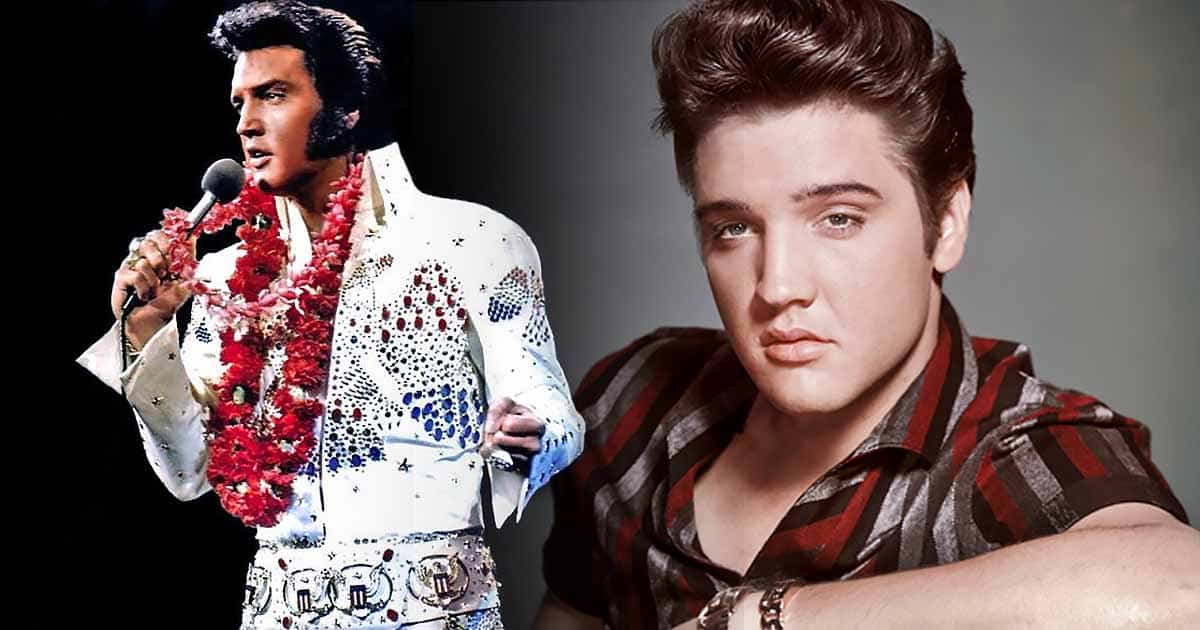
But fame, which had elevated him to unimaginable heights, carried a weight that few could truly understand. What once energized him gradually became something more complicated—something heavier. The relentless demands, the constant scrutiny, the expectation to always be “Elvis” began to take their toll. Behind the legend was a man who, over time, found himself giving more than he could replenish. The same world that celebrated him also, quietly, consumed him.
In his final years, he searched for comfort in whatever form he could find. Prescribed medications became a part of his daily routine, intended to help him rest, to steady the pace of a life that never seemed to slow down. Food, too, became a source of familiarity—simple, grounding, a brief escape from the pressures that followed him everywhere. Those closest to him witnessed the contrast: the performer who could still command a stage with unmatched charisma, and the man behind the curtain who was weary, carrying burdens invisible to the audience. As Elvis once said, “Truth is like the sun. You can shut it out for a time, but it ain’t going away.” His truth extended beyond the music—it lived in the struggle behind it.

And yet, even as life grew more difficult, he never stopped giving. Stories of his generosity endure as vividly as his songs. He bought homes for strangers, gifted cars without hesitation, and offered help quietly, without seeking recognition. That generosity was not an act—it was who he was, untouched by fame’s distortions. It revealed a humanity that fans continue to feel long after the final note fades.
Today, when his voice echoes through speakers, it carries more than nostalgia. It carries presence. It carries memory. Perhaps the true story of Elvis Presley is not defined by the way he died, but by the way he lived—by how he kept showing up, even when it was difficult, and how he gave so much of himself that, decades later, something of him still lingers. In that sense, the silence of that August morning was not an ending, but the beginning of a legacy that refuses to fade.