Introduction:
Merle Haggard’s Final Song: A Farewell Written in Truth and Time
There are artists who gradually retreat from the spotlight, choosing silence when the road becomes too heavy to carry. And then there was Merle Haggard.
In the final chapter of his life, when his body had begun to fail and doctors urged him to rest, Haggard did something entirely consistent with the man he had always been—he kept writing. Battling double pneumonia and struggling with even the simplest physical demands, he ignored the sensible choice. Because for Haggard, life was never about what was sensible. It was about what was true.
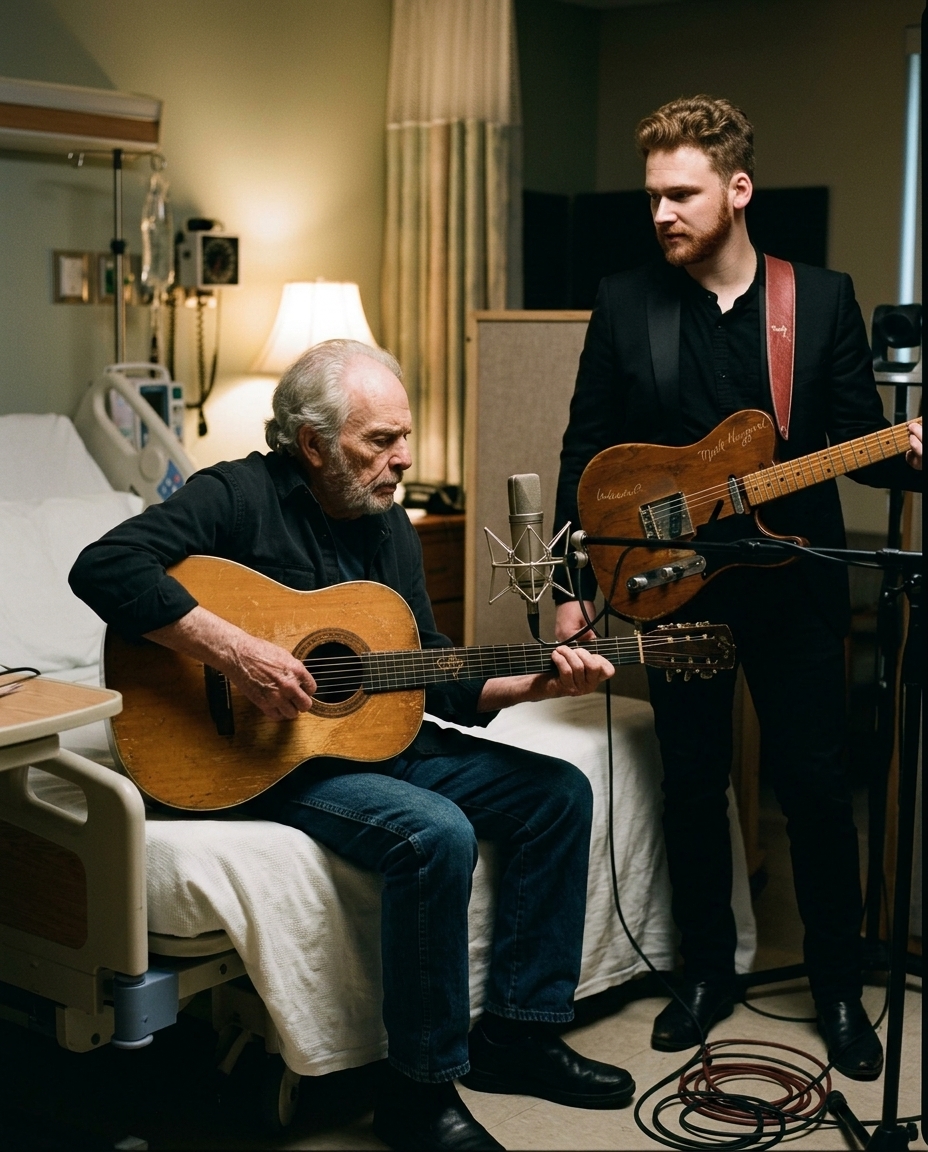
That truth gave rise to one final song—“Kern River Blues.” Written from a hospital bed, it was less a performance and more a quiet, deeply personal farewell. The title alone carried a lifetime of meaning. The Kern River was not merely a place; it was woven into Haggard’s identity. It symbolized the dust and grit of California, the weight of working-class life, and the memories that shaped his voice and vision.

What makes this moment so powerful is its lack of pretense. Haggard was not crafting a grand goodbye for history books. He was simply being himself until the very end—listening for lyrics, shaping emotion into melody, and refusing to let illness silence him.
There is something profoundly revealing in the image of Haggard pushing forward when his body told him to stop. Not because it feels dramatic, but because it feels honest. He was never an artist meant for stillness or preservation behind glass. He belonged in motion—on stage, in the studio, inside the rhythm of a song still taking shape.
And when that final song came, he did not leave it unfinished.
Despite his fragile condition, Haggard made the short but significant walk from his home to his studio—Hag Studio—determined to record. It was a small distance physically, but symbolically, it spoke volumes. At a time when many legends would have long stepped away, he crossed that space because the song mattered. Completing the story mattered.
He was not alone in that moment. His son, Ben Haggard, stood beside him, playing electric guitar. That detail adds a quiet emotional weight to the scene. It was more than a recording session—it was a shared moment between father and son, one filled with understanding, legacy, and an unspoken awareness that this was something rare and fleeting.
On February 9, 2016, Haggard recorded the song. Looking back, the date feels almost sacred. Just 57 days later, he would pass away on his 79th birthday. But in that studio, none of that defined him. He was not a man nearing the end—he was a songwriter finishing his work.

That determination was never about defiance alone. It was about devotion. Haggard believed in songs as vessels of truth. He believed in telling stories honestly, even when those stories were quiet, worn, and marked by time. For him, living and writing were never separate acts—they were one and the same.
His words now echo with deeper meaning: “I’ll never grow tired of playing music, or entertaining people, and I’ll never stop writing songs.” It no longer reads like a simple statement. It feels like a promise fulfilled.
Most careers end with carefully planned farewells, but Haggard’s story closes in a way that feels far more human. Unpolished. Unfinished. As if there was still another verse waiting to be written. There is sadness in that, but also beauty. He did not step away from the work that defined him—he stayed with it until the music itself carried him home.
And perhaps that is why his final chapter resonates so deeply. It does not just tell us how Merle Haggard died. It shows us how he lived—restless, committed, rooted in truth, and forever speaking through song.
That kind of ending cannot be staged.
It can only be lived.