INTRODUCTION:
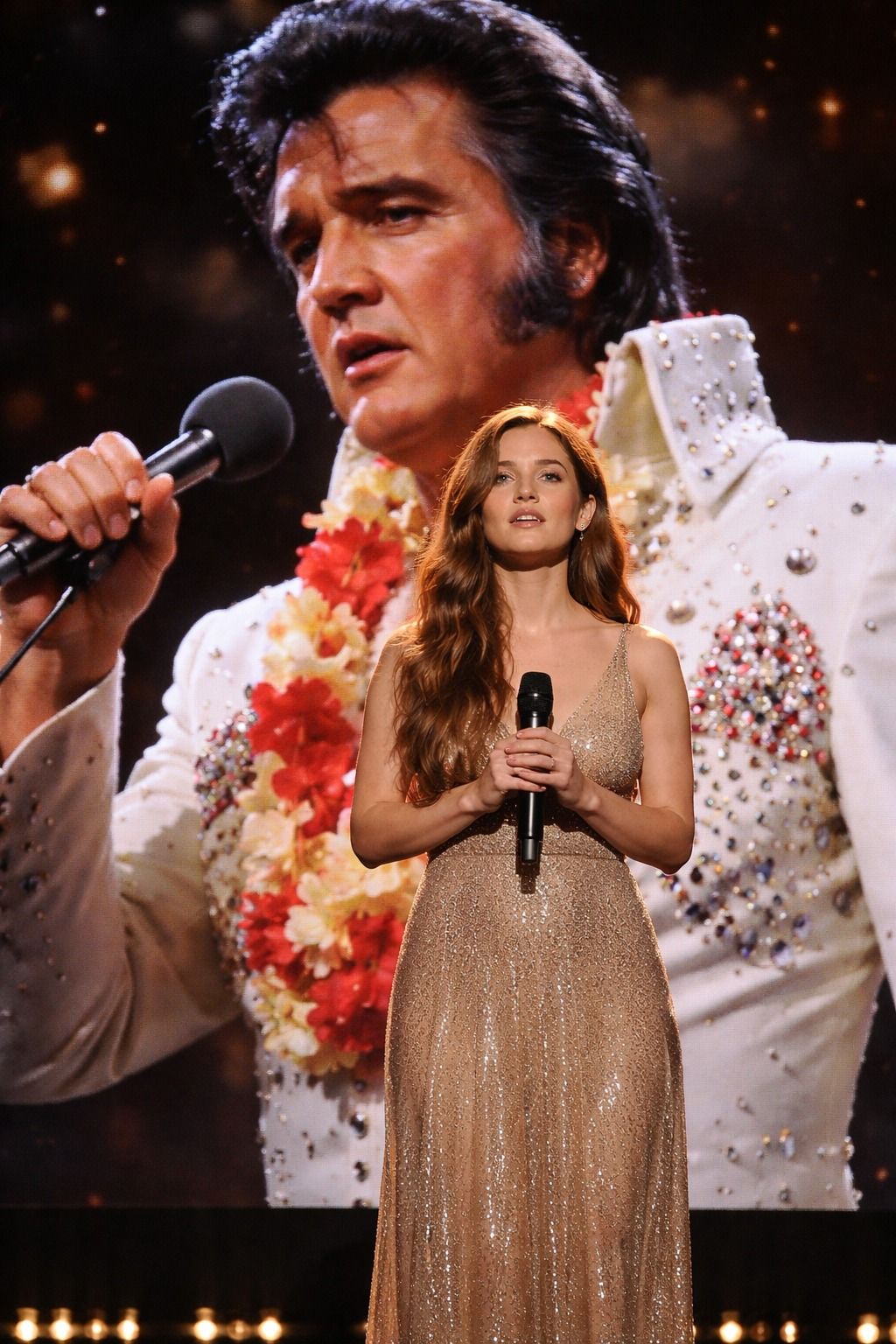
Becoming Her Own Light Inside Riley Keough Choice to Honor a Legend Without Living Inside It
There are names that arrive in the world already heavy with meaning. Names that do not belong only to the person who carries them, but to history, memory, and expectation. The name Riley Keough is one of them. Long before she ever stepped onto a film set, long before critics learned how to pronounce her last name with confidence, the world already had a story prepared for her.
She was born into a lineage that shaped American culture itself. The granddaughter of Elvis Presley. The daughter of Lisa Marie Presley. Royal blood in the most modern sense—fame instead of crowns, records instead of decrees, Graceland instead of a palace. The spotlight was not something she had to chase. It was something waiting for her the moment she decided to claim it.
And that is what makes her story so quietly powerful.
Riley Keough could have traded on the Presley name. She could have leaned into nostalgia, into inherited attention, into the kind of recognition that requires no audition and no proof. The world would have accepted it easily. In many ways, it expected it. But instead of stepping forward and saying, “Look at where I come from,” she chose something far more difficult. She chose to say, “Watch what I can do.”
That decision—to earn her own light rather than borrow someone else’s—defines everything about her career.
Growing up within one of the most scrutinized families in modern history is not a privilege without cost. The Presley legacy is not just admiration and music; it is loss, pressure, and a permanent public gaze. Every choice is interpreted. Every silence is analyzed. Every success is questioned. Is it talent, or inheritance? Is it effort, or access?
For many, that constant questioning would either breed defiance or retreat. Riley chose a third path: discipline.
She did not announce herself with spectacle. She did not rush toward leading roles or demand recognition. Instead, she took parts that were often small, strange, emotionally demanding, and unglamorous. Independent films. Dark characters. Stories that offered no safety net. Work that required her to disappear rather than be recognized.
This was not an accident. It was a strategy—though not in the cynical sense. It was a form of respect. Respect for the craft. Respect for the audience. And perhaps most importantly, respect for the legacy she came from.
To understand that respect, one has to understand the weight of her inheritance. Elvis Presley is not simply remembered; he is mythologized. His image, voice, and story are larger than life, replayed endlessly until the man himself can almost vanish beneath the legend. Lisa Marie Presley, too, lived in that echo—loved deeply, judged harshly, and rarely allowed to exist without comparison.
Riley Keough grew up watching what that kind of attention can do to a person.
So when she chose acting, she did not choose it as an extension of fame. She chose it as a discipline. Acting, for her, became a place where lineage mattered less than truth. Where vulnerability could not be inherited. Where presence had to be real.
There is a quiet bravery in that choice. It means accepting rejection without the protection of the family name. It means hearing criticism without being able to hide behind legacy. It means failing in public and succeeding without applause. It means knowing that if something works, it must work because of you—not because of who your grandfather was.
Her performances reflect this philosophy. They are often restrained, internal, emotionally precise. She does not perform for attention; she invites the viewer closer. There is a sense, watching her, that she is less interested in being seen than in being understood.
This is not the approach of someone trying to escape a famous past. It is the approach of someone trying to honor it properly.
Because honoring a legacy does not mean repeating it. It means carrying forward its values, not its image. Elvis changed music because he felt something deeply and expressed it honestly, even when it made people uncomfortable. Lisa Marie lived her life with raw openness, refusing to smooth the edges for public comfort. Riley, in her own medium, does the same.
She does not ask the audience to remember where she comes from. She asks them to pay attention to what is happening on screen.
That distinction matters.
In an era obsessed with branding and visibility, Riley Keough’s career feels almost old-fashioned. There is patience in it. Restraint. A belief that credibility is built slowly, role by role, rather than announced. She allows time to do its work. She allows her résumé to speak before her name does.
This patience also speaks to maturity—something often overlooked in discussions of young artists. Maturity is not about age. It is about understanding consequences. Riley seems acutely aware of how easily a legacy can become a trap. How quickly a famous name can turn into a ceiling rather than a foundation.
So she keeps her distance from spectacle. She rarely trades in nostalgia. She does not constantly invoke Elvis or Lisa Marie in her work. Not because she is ashamed of them, but because she understands that reverence does not require repetition.
Her respect is quieter than that.
There is also grief woven into her story—grief that does not announce itself but shapes everything. To grow up inside a family marked by public loss is to learn early that fame does not protect what matters most. It teaches you that applause is temporary, but absence is permanent. That lesson, painful as it is, seems to have sharpened her sense of what matters.
Riley Keough’s work often explores isolation, resilience, and identity. These are not abstract themes for her. They are lived realities. When she portrays someone searching for meaning or stability, it does not feel performed. It feels recognized.
And perhaps that is the greatest irony of her journey: by stepping away from the spotlight she was given, she has become someone audiences trust more deeply. Trust cannot be inherited. It must be earned. And she has earned it by choosing honesty over visibility, craft over convenience.
The Presley legacy looms large, but Riley does not stand beneath it. She stands beside it—aware of its scale, respectful of its history, but rooted firmly in her own work. She does not compete with the past. She complements it by proving that legacy can evolve without being diluted.
Her story offers a quiet challenge to anyone who has ever felt defined by where they came from—family expectations, cultural labels, inherited narratives. It suggests that honoring your roots does not require surrendering your voice. It requires developing one strong enough to stand on its own.
Would you live in a legend’s shadow, or would you become your own story?
Riley Keough’s answer is not spoken. It is lived. In the roles she chooses. In the restraint she practices. In the refusal to take shortcuts that would be easy, obvious, and ultimately hollow.
She could have claimed the Presley name and the spotlight that came with it. Instead, she chose something far more enduring: credibility. A light that does not blind, but warms. A presence that does not shout, but stays.
And in doing so, she has shown that the most meaningful way to honor a legend is not to repeat it—but to prove that its spirit is strong enough to inspire something new.